Posts

Science Comics Anyone?
Image
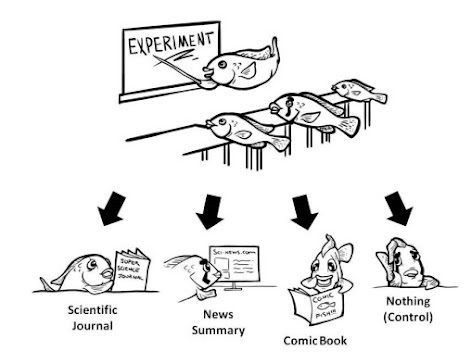
Hello everyone! Tyrone, here! I’m sure you all love reading Burt’s blog, but what if things got a bit more artsy around here? I’m excited to announce my upcoming masterpiece in the making – a comic book starring myself, Toni, Burt and some friendly new fish faces. Why a comic book you ask? While Burt uses writing and this blog to share what he and the scientists are up to, I’m more of a visual guy. I LOVE comics!!! But most people assume they’re restricted to superheros or one style of art (although a Superfish sounds pretty awesome). Comics are actually a sequential art where the shape, size, and relationship between panels conveys just as much information as the text itself. They’re really good at portraying abstract concepts in science that are difficult to convey with words – so I thought I’d give it a try! I’ve turned a big wordy science article published in the Maruska lab into a comic for you readers. I’ve worked really hard storyboarding and sketching a draft for you all. I’ve ...

Brains & Baby Care, Short Stories from the Geaux Girl Fish Power Group!

Image
Hey y’all, it’s Toni here!  Now that the boys Burt and Tyrone are done telling you about their cool news, me and the gals have some even cooler updates for you! The scientists have been pretty busy learning some new things about the brains of us females. Sit back, grab some popcorn, and I’ll tell you 3 different short stories from the Geaux Girl Fish Power group! Story #1: So you may remember that us females are mouthbrooders and we hold our developing babies inside our mouths for a couple of weeks. It’s kind of a drag because during this time, we can’t eat, because we’re such good mothers and we don’t want to eat our kids!, so we’re essentially in a starvation mode. But how do our brains control these behaviors of feeding and caring for our babies? Well, the researchers did an experiment to identify which regions of our brain were involved in feeding compared to maternal care. To do this, they used a neural activation marker called pS6 (they mentioned what that stood for, but it’s...

Model Fish & Model Brains!: Burt’s 3D Printing Adventure

Image
Hello! It’s Burt again. Today, my researcher friends took me outside the lab for a photoshoot. My friends wanted to be able to look at us cichlids outside of the water (why anyone would want to go there, I don’t know). They told us they wanted to make a 3D model of our species, and they chose me to be their study template! We visited LSU’s Communication across the Curriculum (CxC) office and the LSU Engineering Department, where they had me waggle my tailfin for their 3D scanner, and I learned about the 3D scanning and printing process. 3D scanning is the process of using a laser and cameras to analyze an object’s shape, size, and color. As the laser moves over the object, the cameras record the change in distance of the laser. The computer then uses the data to make small triangles or squares in 3D space, in what is called a “point cloud” model. Information from one side isn’t enough, so the scientists asked me to spin around for them so they could take images from lots of angles! Aft...

Burt and Tyrone have Different Smelly Brains!

Image
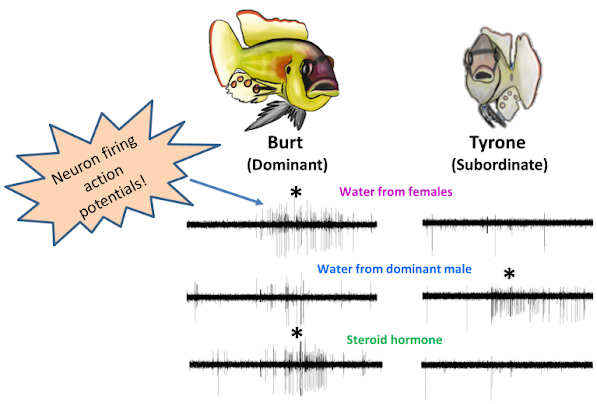
Now that you know we also use pee and olfactory signals to communicate with each other, I want to tell you about another experiment designed to test how the neurons in our brain work to understand these smells.  The scientists put these little needles called electrodes in specific regions of our brain, and then pass water that contains different types of smells (or odors) over our noses to see how our brain responds.  When the neuron they’re recording from gets important information from our olfactory epithelium, it fires what’s called an ‘action potential’ (this is caused by ions like sodium and potassium crossing the cell membrane through channels). The researchers can then compare this firing activity after application of these different smells to determine which ones might be most important to us! In the first experiments, they’re doing these recordings in us males.  Right now, I’m a dominant male, meaning that I successfully defend my territory, mate with the ladies,...

I’ve got sickness on my mind…

Image
Hey guys! It’s Burt again back with more fun science for you to explore. Last time I told you a little about smell and how it helps me communicate with Toni and other fish in my environment. We saw how the delivery and reception of chemical odorants dissolved in the water are important in mediating social interactions. Just as it’s important for me to communicate with Toni and other fish, it’s also important that systems throughout my body are able to communicate between each other, particularly the immune and nervous systems. Just like you, my brain allows me to take in information from my environment, process it, and produce an appropriate response. Although this process takes a lot of energy, I’m able to do this fairly well, which is great because I need to perform a variety of behaviors like finding food, dancing for the ladies, defending my territory, and protecting myself from predators. But recently, I’ve been more concerned with how well I’ll be able to perform these basic func...

OOOooh that smell! Can’t you smell that smell!?

Image
Hello everyone! Today I want to tell you about how I smell my world! You see fish live in water (duh!), which means we constantly smell all of the dissolved odorants that are in the water around us while we swim around. In fact, we use smell for almost everything! I use it for finding food, avoiding becoming food (predator avoidance), navigating, and even finding mates or avoiding other males that may want to fight. Fishes have a sensitive “nose” comprised of an olfactory epithelium full of olfactory receptor neurons (ORNs) that detect all kinds of different smells. Each type of neuron detects a certain “type” of smell. For example, ones called ‘crypt neurons’ detect pheromones (which help me find my special friend Toni! ;)). Each of these different types of ORNs sends signals to a specific region in my olfactory bulb at the very front of my brain. You see, my olfactory bulb is a sorting center for all of these different kinds of smells. From there, the signals go on to other parts of ...

Looking on the bright side of a long snowy winter

Image
Greetings from Minnesota! That’s right, Toni and I took a trip to the tundra! Why? Well we’re visiting some friends up here in Dr. Allen Mensinger’s lab at the University of Minnesota at Duluth. They’re helping Julie check our vision using this technique called electroretinograms (but more on that in a minute!). If you haven’t already noticed, I’m pretty awesome and brightly colored. And I do this little dance for Toni when I’m trying to get her to spawn with me. Like a lot of animals, we primarily use visual signals during reproduction. When I’m ready to mate, or around Toni when she’s ready to mate, I produce A LOT more of these visual signals (check out some of them in this picture!). But what my humans are interested in testing is if Toni’s ability to detect my dance and colors changes with her reproductive state. We already know she can probably hear me better when she’s ready to mate (read about that here), but maybe she can see me better too!! How cool would that be?!?! They’ve...

Balancing Act

Image
Hi everyone! It’s Toni again! Last time I talked about mouth brooding and how I carry my developing young in my mouth. As they develop and grow, they also increase in weight. This affects my buoyancy… Imagine having a weight strapped to just one side of your body! You’d probably walk a little crooked. Luckily, I have a way to fix this so my kids don’t bring me down (literally, and face-first)! The humans took me on a field trip to the LSU Museum on Natural Science where they got to work with a really cool guy named Prosanta Chakrabarty (he’s an Ichthyologist, or scientist that studies fishes). Once there, they took x-ray images of me and my friends. Some of us were gravid (that means we have big eggs and are ready-to-reproduce). Others were mouth brooding, and some of my friends were in between (or recovering). When they looked at these pictures, they noticed that the swim bladder, an air-filled sac in the body, looked different depending on our reproductive state. The swim bladder h...

Extreme maternal care

Image
Hey Y’ALL! (there’s that Louisiana vocab again!).  It’s Toni here, and in this post I want to share some more about some cool research looking at our maternal care behaviors.  Last time, I told you about how us females are mouth brooders, which means we hold our babies inside our mouths for ~2 weeks until they’re fully developed and can swim out on their own. During this time, we can’t really eat, so we’re pretty much starving and lose lots of weight, all to keep our babies happy and healthy! – this is extreme maternal care at its best!  Since we’re pretty hungry, we swim up to the food dropped in our tanks but stop ourselves before eating it when we remember those little guys already in our mouths.  As the babies get bigger, they get heavier too and to keep ourselves from doing a nosedive to the bottom, some adjustments are made in our swim bladders to keep us swimming straight (but that’s a story for another time!).  Anyway, once the babies are grown, we open ...

The lateral line – my superpower

Image
Hi there! For this post, I want to talk about dancing. That’s right folks, I perform a little dance when I’m trying to get Toni or the other ladies to hang out with me. I also do this move called a “lateral display” where I make myself look really big and shake my body at other males to threaten them. When I fight with other males, we push around a lot of water at each other. If we can’t resolve our fight with these behaviors, then we go to the more dangerous behaviors, like biting each other. See fish have this thing called the mechanosensory lateral line. It’s composed of these little bundles, called neuromasts, that are on my skin or inside canals beneath my skin. These neuromasts have little hair cells on them that are covered by a jelly-like mass called the cupula. When something near me moves in the water, it creates water motion that deflects the cupula over these neuromasts and opens mechanically gated ion channels on the hair cells. This information then gets sent to my brain....

Geaux girl fish power!

Image
Hello everyone! I’m Burt’s friend Toni and I want to tell you a little more about us females – Geaux girl fish power! (a bit of Louisiana is creeping into my vocabulary!). While Burt and his other male territorial buddies are really colorful, us ladies are less flashy and we often hang out with the subordinate males (those without a territory). Burt and his macho friends often chase us around, and when the time is right, they also do all kinds of other crazy things in front of us! When our eggs grow large in our ovaries, our bellies get swollen, we have an urge to get rid of them, and we release some chemicals into the water that makes the males do awesome courtship dances. They get really bright colors, quiver their bodies, and make grunt-like sounds in front of us, and then they turn around and wag their tails as they swim towards their territory shelter – they really want us to follow them! When one of us girls agrees to follow him, we go into his territory and lay some of our large...

Hormones, brain, and behavior – A review of SBN 2017!

Image
Hi there! I just got back from sunny California where I attended the Society for Behavioral Neuroendocrinology (SBN) meeting! There was a lot of great research and I had a great time. I was especially excited to learn about some of the research being presented about me and my family. Check out a quick synopsis about the cichlid research that was presented at SBN 2017. JULIE BUTLER : SOCIAL STATUS AND BEHAVIORAL CONTEXT REGULATE EXPRESSION AND ACTIVATION OF TACHYKININ3A NEURONS IN THE BRAIN OF A SOCIAL AFRICAN CICHLID FISH Reproduction is really important. Neurons in my brain make sure that my reproductive system stays in tip-top shape. There’s this gene called tachykinin3 that helps regulate reproduction in mammals (like dogs, cats, and even humans!), but we don’t really know what it does in fish. Julie found that these neurons are located throughout my brain, not just in the one place that’s been so well studied in mammals. She also found that dominant males, like me, have more of th...

Can you hear me now?

Image
Hey everyone, thanks for coming back! Today I want to tell you about acoustic communication. Not only can fish hear, but a lot of us make sounds too! While we don’t actually ‘talk’, like seen in the movies, we do make sounds for a variety of reasons. Different fish produce sounds using different mechanisms, but the purpose is the same: to communicate with other nearby fish. My friend Todd the Toadfish does it to advertise his location and attract females. Like him, I produce sounds when courting the ladies1. I only make the sounds when performing a little dance, called a courtship quiver, in front of a female (click here for a video of me quivering and to hear the sounds I make). They like it. Actually, females prefer males that make sounds over those that don’t. So the more sounds I make, the more likely I am to get the ladies back to my pot! My human scientists don’t know exactly how I make sounds, but one of my cousins, Niles (a tilapia fish) makes sounds by shaking his body and c...

My amazing fishy senses

Image
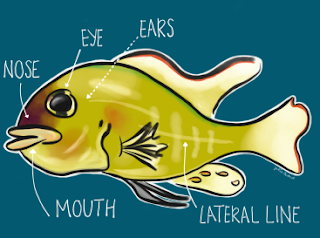
Hi everyone! Thanks for coming back to my blog! Today I want to talk a little about fish sensory systems. Don’t worry, I’ll focus more in depth on each sense later! Let’s see… where should I begin? Well did you know that I can see, hear, smell, and taste – just like you! My eyes work pretty similar to yours. Light is focused by a crystalline lens onto the retina. Like most fishes, I actually have really good color vision – that comes in handy when you’re really colorful like me. These bright colors can mean different things. My bright yellow coloring shows that I’m a dominant male defending a territory. Some of my friends are bright blue instead of yellow, but they’re also guarding a territory. Sometimes I have a dark bar across my eye. This is a sign of aggression, but sometimes it just means I’m stressed. I can also turn on and off a red patch on my body that I use during reproduction. I can hear sounds too! Even though I don’t have an external ear that you can see, I have an inner e...

Hi! I’m Burt!

Image
Hi there! My name is Burt. I’m an African cichlid fish – Astatotilapia burtoni. It’s nice to meet you! You may not know this, but fish are kinda awesome. I decided to start a blog to talk about how great we are and tell you some cool biology facts about us. My friend Toni may occasionally help out too! Here’s a picture of us at the recent #SwimForScience event. First, let me tell you a little about myself. Although I was raised in the Maruska lab in good ole Baton Rouge, LA, my ancestors are originally from Lake Tanganyika in eastern Africa. Back in the 1970s a group of researchers realized how awesome we were and decided to study us. Gradually my family spread out around the world. Now, some of us live in Austin, TX , Palo Alto, CA , Portland, OR , Baton Rouge, LA , College Park, MD , New York, NY , and even Europe! Using my family, researchers over the past 40 years have discovered some pretty cool stuff about fish sensory systems and how fish brains function during behaviors. Keep c...